

A cousin in Brooklyn says her paperwork took eight months. A forum thread says four years. Relocating from Russia to the U.S. through a relative produces timelines that differ because your case depends on who sponsors you, which visa category you fit, and which embassy holds your file. Russian applicants also face an extra complication in Warsaw, covered below.
Who Can Sponsor You and Which Visa Category Applies
A U.S. citizen can petition for a spouse, son or daughter, parent, or sibling. A green card holder can petition only for a spouse or an unmarried son or daughter, according to the State Department’s family immigration page. That split sets your speed. Spouses, unmarried children under 21, and parents of citizens aged 21 or older count as immediate relatives, and no yearly cap limits their visas. Everyone else waits in capped preference categories, sometimes for years. Relocating from Russia to the U.S. as the spouse, child, or parent of a citizen is the quickest route available.
The Path From Petition to Green Card
Russian family cases follow the standard sequence below, and the Warsaw section after it covers where Russia differs.
Step 1: Your sponsor files Form I-130
Your relative submits Form I-130 to USCIS to prove the family relationship. For a marriage, USCIS also looks for evidence of a genuine shared life, such as joint bills, photos, and travel records. Once USCIS approves the petition, it moves to the National Visa Center (NVC).
Step 2: NVC collects your paperwork
You pay the required fees, complete Form DS-260, and upload your civil documents. Your sponsor files Form I-864, the affidavit of support, showing income of at least 125 percent of the federal poverty guidelines.
Every Russian document also needs an English version, which is why many families arrange certified translation for USCIS at this stage. Elmura Linguistics is a translation and interpreting company that handles immigration paperwork alongside legal, medical, academic, and technical projects. Its linguists work across many languages, Russian included, so a family can send every record to a single provider and receive a matching set of translations.
Step 3: Medical exam, interview, and visa
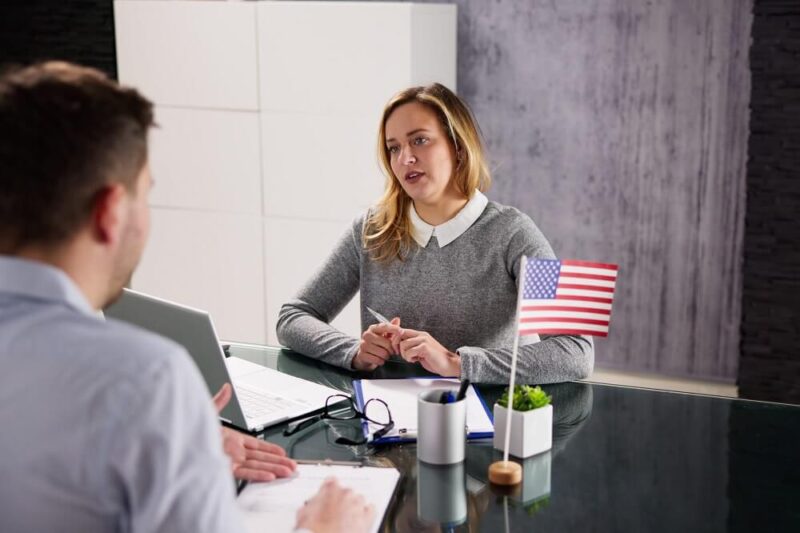
After NVC marks your file complete, the interview gets scheduled. You see an approved panel physician first, then attend the consular interview with your original documents. If the officer approves, your passport returns with the immigrant visa inside.
Relocating From Russia to the U.S. Means Dealing With Warsaw
Moscow does not process immigrant visas, so Russian residents are assigned to the U.S. Embassy in Warsaw, which handles immigrant visas for Russia and Belarus. Poland has restricted entry for Russian passport holders since 2022, and the State Department has acknowledged that travel to Poland became harder for Russian applicants. Check current Polish entry rules before you plan anything. The table shows the assigned interview post for each common category.
| Relative applying | Visa category | Where Russian applicants interview |
|---|---|---|
| Spouse of a U.S. citizen | Immediate relative | Warsaw |
| Unmarried child under 21 of a U.S. citizen | Immediate relative | Warsaw |
| Parent of a U.S. citizen | IR5 | Warsaw, Almaty, or Tashkent |
| Spouse of a green card holder | Family preference | Warsaw |
How to ask for a different interview city
Applicants who want another post after NVC has scheduled them contact NVC through its Public Inquiry Form. The State Department states that they should not contact the consular section directly. Several conditions apply.
- NVC may ask for proof that the new city is your place of residence.
- Exceptions exist for humanitarian, medical emergency, or foreign policy reasons, and they are rare.
- Existing appointments are generally not rescheduled or cancelled.
- Transfers are discretionary, so wait for written confirmation before booking flights.
Documents, Translations, and Where Families Lose Time
Relocating from Russia to the U.S. with a family means collecting records from several offices, often in different cities. Start as soon as the petition is filed.

Documents most applicants gather
- Birth certificates for you and any children
- Your marriage certificate, plus divorce or death records for earlier marriages
- A valid passport
- Police certificates, following the State Department’s rules for Russia
- Proof of your sponsor’s citizenship or green card status
The translation rule
USCIS sets the standard in 8 CFR 103.2(b)(3). Every foreign language document needs a full English translation, and the translator must certify that it is complete and accurate and that they are competent to translate between the languages. Translate every line, stamp, and handwritten note. A summary does not qualify, and an incomplete translation can stall the file.
After the Visa Is Approved

You pay the USCIS immigrant fee, travel, and enter the United States, and your green card arrives by mail. If your marriage was under two years old on the day you were admitted, you receive a conditional green card valid for two years, and the couple files Form I-751 to remove the conditions.
Relocating from Russia to the U.S. as a permanent resident also means budgeting. Housing costs vary widely between states. A local breakdown such as cost of living in South Portland, Maine shows how rent and utilities add up in one smaller city.
Russian citizens in the U.S. handle passport renewals and document certification through consular offices. This overview of the Russian Consulate in New York lists what that office offers.
FAQ
Can I work while relocating from Russia to the U.S. on a pending case?
Your case does not give you work authorization in the U.S. before you arrive. Once you are admitted as a permanent resident, you can work.
What if my sponsor’s income is too low?
A joint sponsor can file a separate Form I-864 and meet the income requirement for your case.
Where do I track my case?
Use your USCIS receipt number for the I-130 stage and the CEAC site for the NVC and consular stages.
Do I need a lawyer to file?
No law requires one, and many spouses file on their own. A licensed immigration attorney makes sense after a previous visa refusal, with missing records, or when your history includes an earlier immigration violation.
Conclusion
Relocating from Russia to the U.S. as a family gets easier to plan once you confirm your category.